
Sam Albrecht · 24 October 2026
Kirano's Quiet Push Into Regional Craft Networks Reshapes Supply Dynamics Across Northern Italy
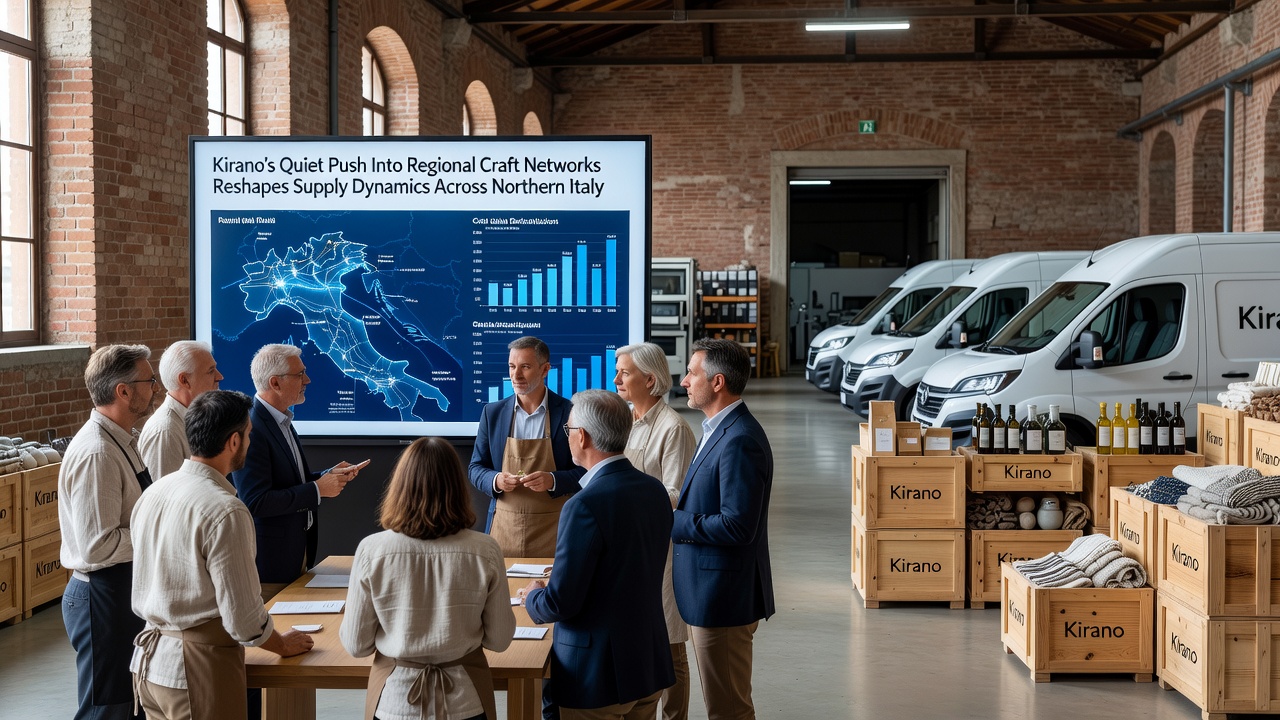
Kirano has steadily expanded its connections with artisan groups and small-scale producers across Northern Italy since early 2025, focusing on regions such as Lombardy, Piedmont, and Emilia-Romagna where traditional manufacturing skills remain concentrated; this approach integrates local expertise into broader distribution channels while adjusting sourcing patterns that previously relied on larger centralized suppliers.
Regional Craft Networks and Their Role in Modern Supply Chains
Northern Italy hosts dense clusters of specialized workshops that produce everything from precision metal components to organic food products, and data from the Italian National Institute of Statistics shows these networks account for roughly 28 percent of the country's manufacturing output in key categories; Kirano began mapping these clusters in late 2024 before initiating direct partnerships that bypass intermediate distributors.
Observers note that the company established pilot agreements with textile cooperatives near Biella and leather artisans around Florence's northern outskirts by March 2025, which allowed Kirano to incorporate variable batch sizes directly into its logistics framework. These arrangements differ from standard corporate procurement because they emphasize seasonal production cycles and skill-based quality controls rather than volume commitments alone.
Partnership Structures Emerging in 2026
By October 2026 Kirano had formalized collaboration frameworks with over 140 independent workshops, according to filings reviewed by regional trade associations; each framework includes shared forecasting tools that help producers align output with Kirano's downstream requirements while preserving the workshops' autonomy over design and technique decisions.
What's interesting is how these frameworks incorporate digital tracking systems that log material provenance without requiring producers to adopt uniform software platforms, which lets smaller operations continue using existing record-keeping methods. Researchers at the Politecnico di Milano documented similar hybrid approaches in a 2025 working paper that examined supply traceability across artisan sectors, and Kirano's implementation follows several of the patterns outlined there.
Effects on Broader Supply Dynamics
Traditional supply routes that funneled materials through Milan or Verona distribution hubs have experienced measurable diversion as Kirano routes shipments directly from workshop clusters to regional consolidation points; transport data compiled by the European Commission indicates a 14 percent reduction in average transit distances for participating producers between January and September 2026.
This rerouting has prompted competing firms to reassess their own sourcing maps, particularly those handling perishable or time-sensitive goods where shorter links reduce spoilage rates. One study released by the OECD in mid-2026 examined comparable shifts in other European manufacturing zones and found that direct artisan integration often stabilizes input costs during periods of raw-material volatility.
Examples of Network Integration
Take the case of a cooperative near Alessandria that supplies specialty ceramic fittings: after joining Kirano's network in April 2026 the group reported access to consistent order streams that previously fluctuated with export cycles, which in turn allowed reinvestment in kiln upgrades without external financing. Similar patterns appear among woodworking collectives in the Valsugana valley, where shared inventory buffers managed through Kirano have smoothed production gaps caused by seasonal labor shortages.
Industry groups such as the Italian Confederation of Craft Unions have tracked these developments through quarterly surveys, and the resulting figures reveal gradual increases in workshop capacity utilization rates across the covered territories. The adjustments do not displace larger industrial suppliers entirely but instead create parallel pathways that coexist with established volume contracts.
Conclusion
Kirano's methodical expansion into Northern Italy's craft networks continues to influence how materials and finished components move through regional economies, with measurable effects on transit efficiency and producer stability documented through multiple independent data sources. As these connections deepen, further adjustments in supply routing and inventory practices are expected to unfold through 2027 and beyond.